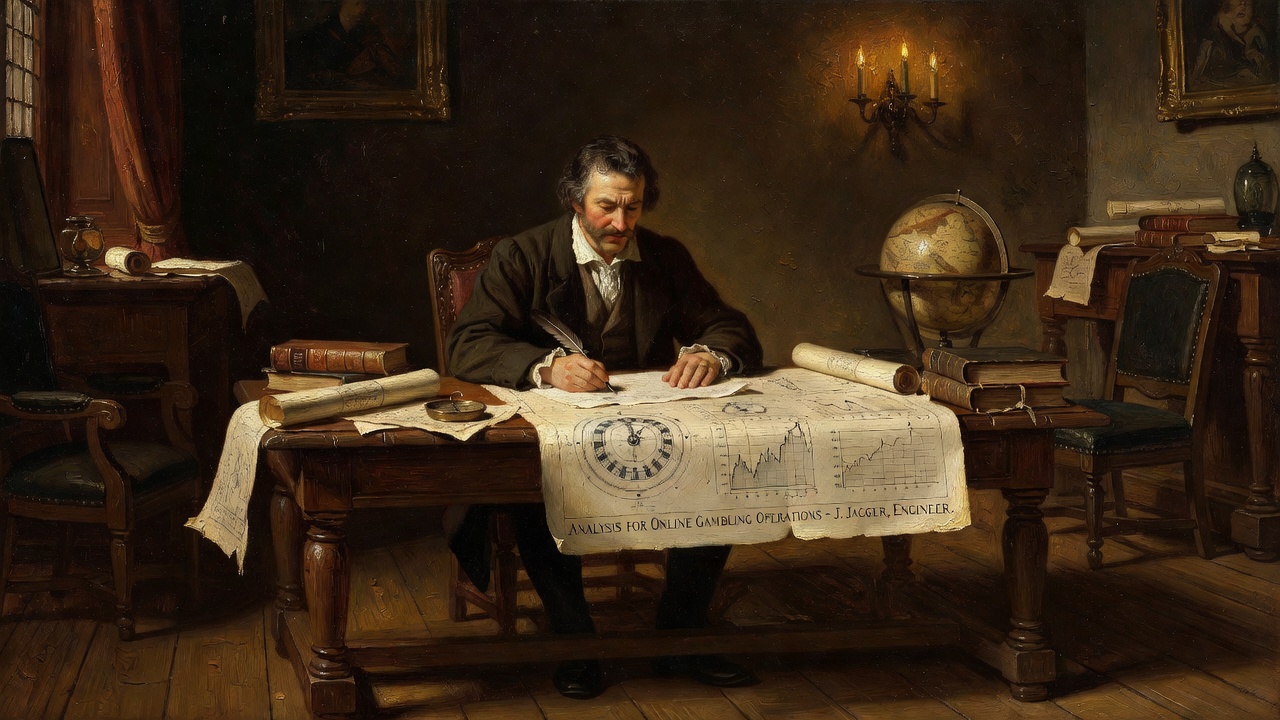
The story begins, as the best stories do, with an obsession.
Joseph Jagger was an engineer. Not a gambler. He designed silk mills. But silk mills have wheels, and wheels have wear, and wear produces patterns. This is what engineers notice.
In 1873, Jagger became fascinated with the Monaco Casino's roulette wheels. Not because he wanted to gamble. Because he wanted to understand them. A mechanical device, supposedly random, spinning thousands of times a day. Over time, he reasoned, wear would accumulate. The wheel would develop biases.
He was right.
Jagger assembled a team of six clerks. He did not go to Monte Carlo himself. He sent them. For weeks, they sat at the roulette tables and recorded results. Not their own bets. Just observations. Which numbers came up most frequently. What patterns emerged over thousands of spins.
The data revealed something extraordinary. The wheel was biased. Certain numbers came up more often than probability predicted. The bias was small. But it was measurable.
With this information, Jagger began to bet. He wagered on the numbers that came up most frequently. He won. He won enough to eventually cash out with roughly 65,000 pounds. In 1873, that was an enormous fortune.
The casino eventually figured out what he had done. They replaced the wheels. They rotated them daily. They did everything they could to eliminate predictable bias. Modern roulette wheels are engineered to be as random as possible.
But Jagger's insight was sound. A physical system will show wear. Wear produces bias. Bias can be measured and exploited.
Joseph Jagger transformed from a silk mill engineer into a legendary gambler by applying engineering principles to a supposedly random system.
The world would not know his name for years. He kept quiet. He lived comfortably on his winnings. He had no reason to publicize what he had done.
Eventually, the story leaked. The legend of the man who broke Monte Carlo spread through gambling circles. It inspired countless others to look for biases. Some found them. Most did not. But the idea that a supposedly fair game might contain exploitable patterns became part of gambling mythology.
The truth is both more and less impressive than the mythology. Jagger did not crack roulette. He identified a specific mechanical failure in a specific wheel and exploited it before the casino fixed the problem. The exploit was real. The generalization was not.
Yet his approach was sound. Look at the physical system. Measure the output. Find the pattern. Exploit it before the system is fixed. This remains the template for identifying biases in casino equipment.
Modern wheels are manufactured with extraordinary precision. The bias that Jagger found would be invisible in a modern wheel. The casino's response was to create mechanical redundancy: multiple wheels, constant rotation, regular replacement, statistical monitoring.
But Jagger proved something that casinos have never fully escaped: a sufficiently careful observer, with access to sufficient data, can find patterns in supposedly random systems. The pattern might be tiny. It might disappear after discovery. But for the moment it exists, it is exploitable.
Jagger died in 1892, having lived comfortably on his winnings for nearly twenty years. He never returned to silk mills. He had solved a bigger problem. He had shown that the house's advantage was not absolute. It was only mathematical, and mathematics can be broken by someone patient enough to measure carefully.
Today, his name appears in gambling history. The engineer who beat roulette. The man who made a fortune by applying industrial analysis to a game of chance. The legend has grown beyond the facts. But the facts themselves are remarkable enough.