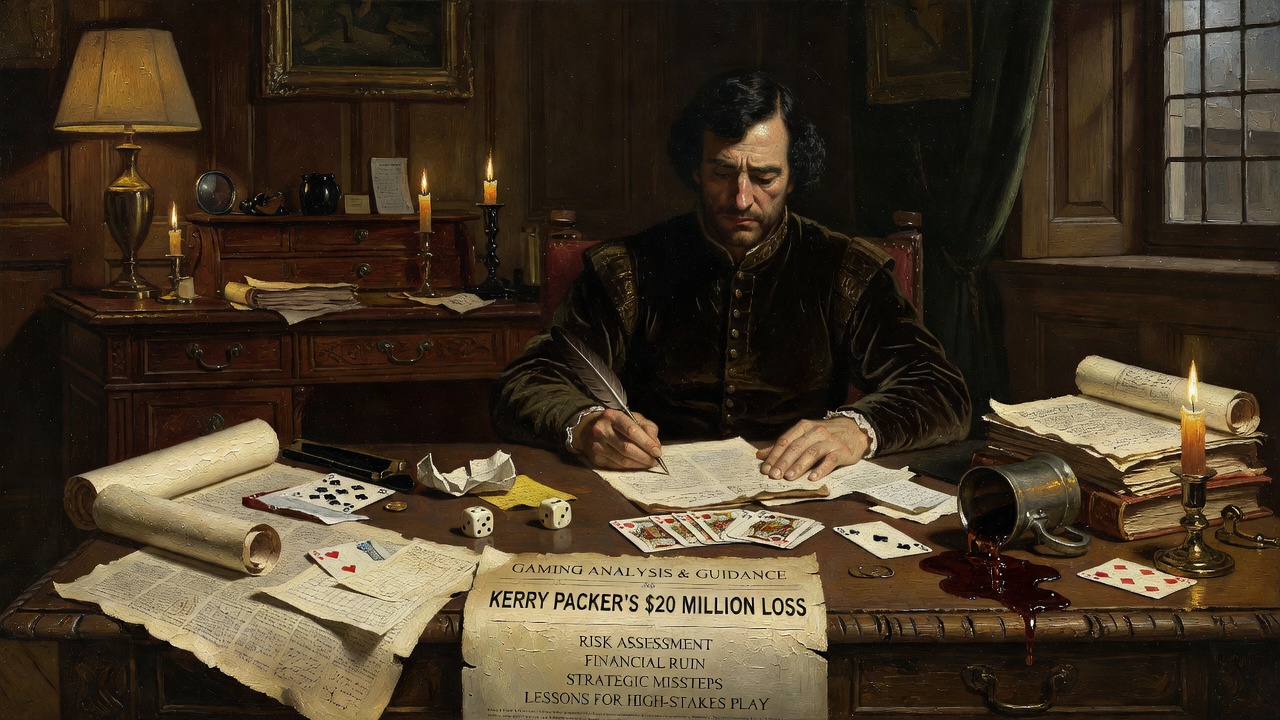
It was 1992, and Kerry Packer was in that particular mood. You know the one. He'd made billions in Australian media. Television, mining interests, publishing. The kind of money that makes normal economics irrelevant. He was at the MGM Grand, and he decided he was going to play baccarat like a man who had nothing left to prove.
Packer was a big player. Not a movie-style big player, not a guy who yells about luck. A quiet big player. The kind who has seventeen people managing his affairs and still decides to sit down at a table and move three million dollars in an evening like it was conversation.
The game was baccarat. This matters because baccarat is the game where money moves fastest. You're not contemplating your decisions. Banker or Player. Win or lose. The game moves in heartbeats.
The Setup
Packer came with a crew. Not security, exactly, though there was that. People who kept track of things. The casino set up a game specifically for him. High-limit room, probably filled with the kind of air-conditioning that costs more per hour than most people make in a year.
The stakes were eye-watering. Not the specific numbers; the casino never discussed Packer's numbers publicly. But the reporting suggested he was betting anywhere from $100,000 to $500,000 per hand. In baccarat, a hand lasts maybe thirty seconds. The money moves at a clip that makes standard casino procedures look like kindergarten counting.
He lost $20 million. That's the headline, and it's the number everyone cites. What's harder to understand is what that actually meant. For most people, $20 million is generational wealth. For Packer, it was a bad week of gambling. Irritating, the way losing $200 at the slots is irritating to a doctor on vacation.
What Actually Happened
Accounts vary, as they always do in these stories. Some said he was down and chasing. Some said he was simply playing at a level where the variance had to surface eventually. Baccarat with a 1.06% house edge looks fine over 100 hands. Over 1,000 hands at that level of betting, you're moving millions of dollars in pure variance.
The casino was happy to oblige. This is not a moral failing on their part. Packer was an adult with resources. He knew the game. The casino's job was to let the game run. And it did.
What strikes most people about the story is that it didn't destroy him. That's the real headline. A $20 million loss that would bankrupt a country, and Packer went home irritated.
The Theater of It
Gambling at that level becomes theater. The amounts are so large they stop being real. You're not thinking about money anymore. You're thinking about the action, the swings, the purity of luck against probability. Packer was not trying to win money he needed. He was trying to feel something.
Baccarat is perfect for that. There's no skill to hide behind. No strategy to blame. Just you and a shoe of cards and a banker opposite you who doesn't care who you are. The game is honest in a way that nothing else is.
The Aftermath
Packer walked away and went back to his life. The casino made a story out of it for years. The significance was in the size, not in the suffering. That's actually worse than losing and being crushed, in some ways. It says something about what that level of wealth does to the weight of consequences.
He came back to Vegas later. That's the part that haunts the story. Not that he lost $20 million. That he came back. That the draw of the action was strong enough to pull him back to a table where the odds were his enemy and the house had already taken him for more money than most people will see in ten lifetimes.
Packer died in 2014, at eighty-three. The MGM Grand is still standing. The high-limit room is still there, and millionaires are still sitting at tables, moving money at speeds that don't compute until you write them down. The casino is betting, as it always does, that the draw will pull them back. And sometimes, it does.