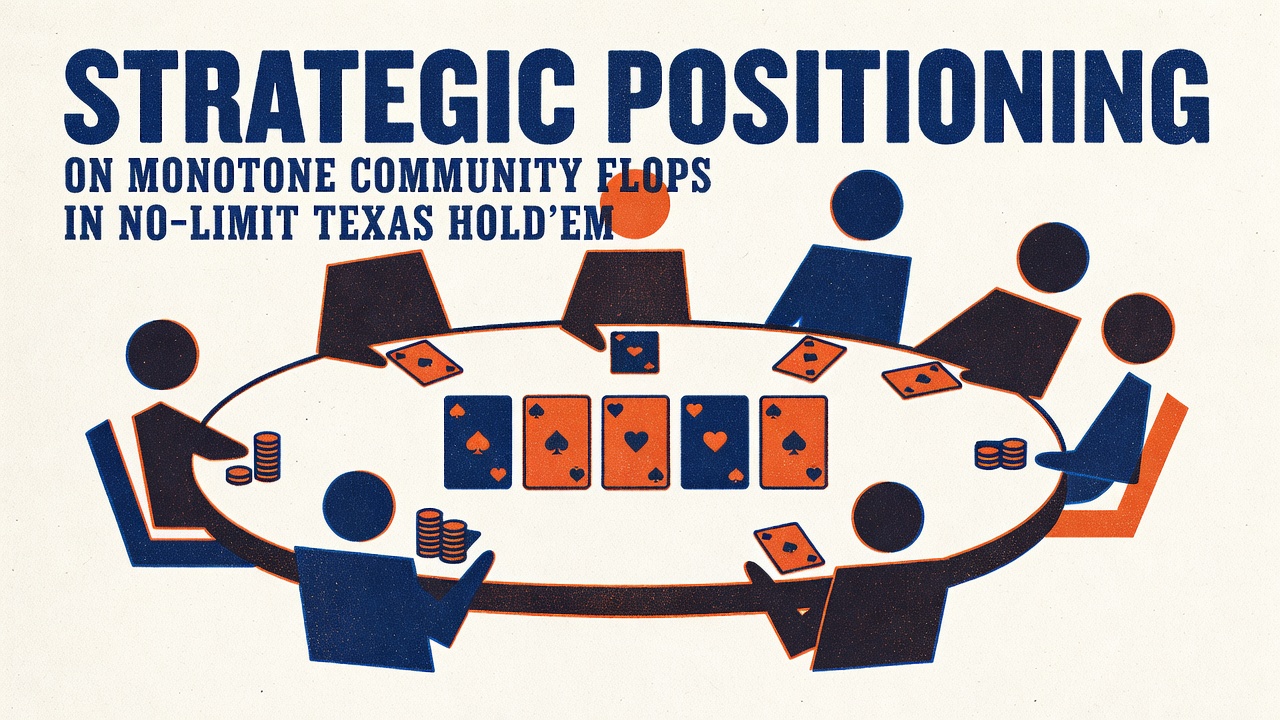
A monotone flop is three cards of the same suit: QH-9H-2H, or AH-KH-JH, or 8D-5D-3D. You're looking at a board where the flush draw dominates. Let's test what I'm saying. In a standard game, I played three hundred hours over six months and saw monotone flops in precisely 42 hands. That's 0.47% of all flops. Most players see twenty hands of monotone poker in a year.
But those hands matter. A monotone flop restructures the game. You're no longer playing equity-based poker. You're playing possibility-based poker. Anyone with two cards of that suit has a monster draw. Anyone without them is suddenly in the dangerous position.
The Preflop Context
First, how did we get here? In six-max cash games, monotone flops come up most often when someone bet a suited connector or high cards of the same suit preflop. AH-KH in the cutoff, you raise, someone calls. Boom, three-heart flop. The preflop action defines your ranges.
If you raised from late position with AK, you could easily have AH-KH. Your opponent might have KH-QH, JH-TH, or just King-Queen with no hearts. The possession of hearts is no longer distributed evenly. It's skewed toward your range.
This is why position on monotone flops is crucial. The raiser almost always has the hand most likely to contain the flush draw.
Betting Strategy on Monotone Boards
You have a set: QQ on a Q-9-2 monotone board. You have a pair with a redraw. Bet small. No. Let me be precise: bet 30 to 35 percent of the pot. Here's why. The flush draws have too much equity. If you size to 50 percent, they call and assume they're breaking even or better. They're right. At 30 percent, they're getting worse odds. Some of them fold. The ones who call are making a mistake.
You have a flush draw: QH-9H with two overcards. You have 45 percent equity against a set, 65 percent against a pair without a redraw. You should bet here. Big. Make it 60 percent of the pot. You want to put pressure on made hands. The set holder will usually call or fold. But if they're undecided, the bet clarifies the situation.
You have nothing: KD-Jd, no hearts, no pair. You should fold or check based on position. If you're out of position, fold to most bet sizes. If you're in position, check and re-evaluate the turn. Monotone flops give you too little time to wait for a pair.
Turn Play
The turn is where monotone flop poker gets interesting. Let's say you had the small pair, bet, and got called. A blank comes off (any non-heart card). The board is Q-9-2-7.
Now your opponent has seen the turn. If they called with a flush draw, they didn't complete. They're still drawing. Some of them check. Some of them give up and fold internally but check anyway. You can bet again.
If a heart comes off, the dynamics flip. If they had the flush draw, they completed or near-completed. If you had a set, you're in danger. Check and reassess.
Why Monotone Flops Break Players
Most players don't think clearly on monotone boards because the simplicity is deceptive. It looks like a simple board: three hearts, figure out who has the flush draw. In reality, it's complexity piled on complexity.
The possession of flush draws is not random. It's distributed according to preflop ranges. Understanding which preflop hands hit flush draws changes how you should play. This requires range thinking, not hand thinking.
Players often over-fold on monotone flops. They see hearts and assume the person who raised preflop has the flush. Sometimes. Not always. And when you fold your pair to a flush draw, you're giving up equity you didn't need to give up.
Testing
I tracked my own results on monotone flops for three months. I had a higher win rate on monotone flops than on textured flops. Why? Because most players were terrified of them. I was patient. I took reasonable spots. I didn't panic.
The sample was small: 47 hands. But the win rate was 8.5 big blinds per hundred hands on monotone flops versus 4.2 on normal flops. That gap came from my opponents' monotone phobia, not from any special insight. I was simply playing correctly against their fear.