The question of how much to bet has occupied gamblers for centuries. Flat betting is simple: always wager the same amount. Unit sizing is adaptive: scale your bets based on your bankroll.
History and mathematics both favor unit sizing.
Flat Betting
Flat betting means you pick an amount and stick to it. You bring 1,000 dollars. You bet 10 dollars per hand for 100 hands. Win or lose, you bet 10 on every hand.
The advantage is simplicity. No mental math. No adjustment. You know exactly how many hands you can play.
The disadvantage is poor capital management. If you win the first 50 hands, you have 1,500 dollars. But you keep betting 10. You've wasted bankroll growth.
If you lose 50 hands, you have 500 dollars left. But you keep betting 10. You're playing with a smaller cushion and same stake. The variance kills you.
Unit Sizing
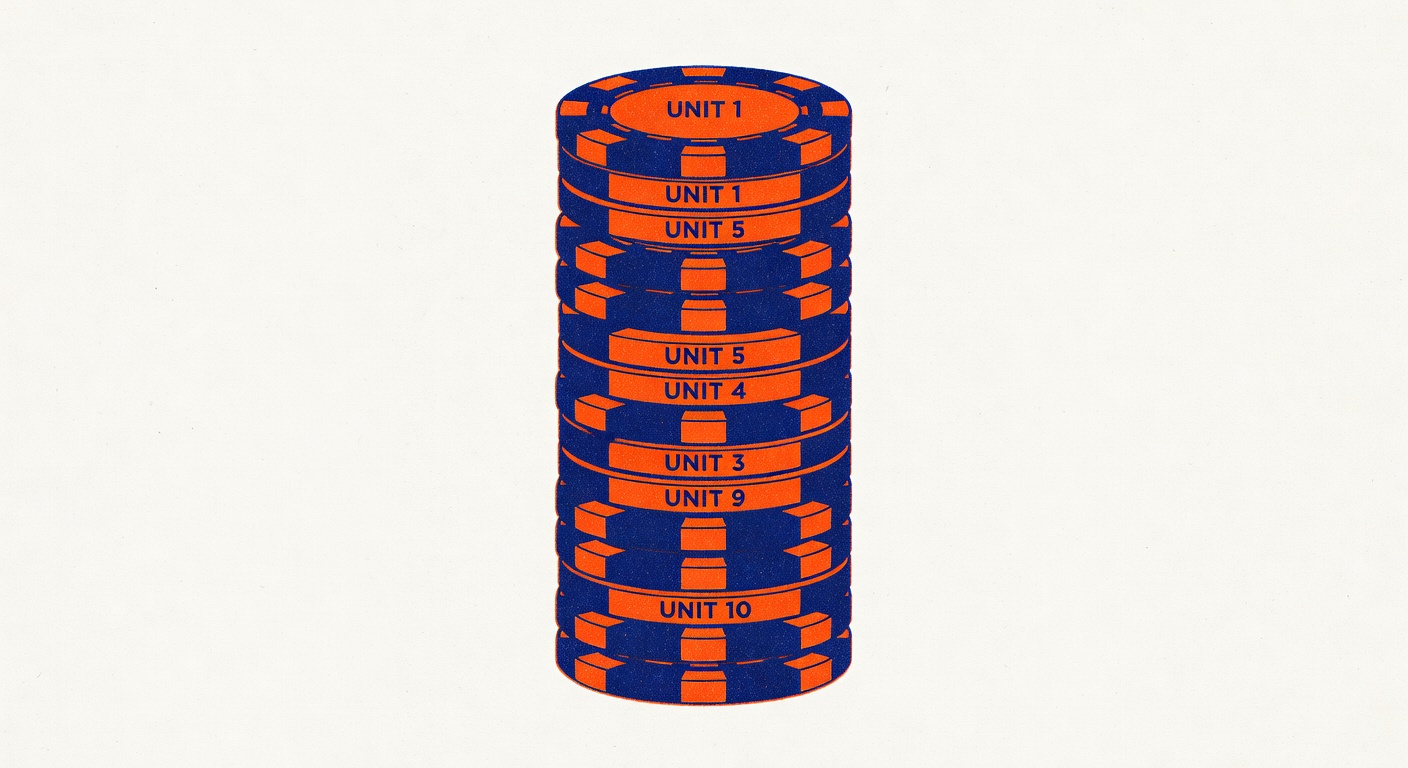
Unit sizing means your bet is a percentage of your bankroll. Let's say you pick 1 percent of your bankroll as one unit.
You start with 1,000. One unit is 10. You bet one unit.
You win. Now you have 1,010. One unit is now 10.10. You bet one unit.
You lose. You have 1,000.90. One unit is now 10.01. You bet one unit.
Your bet scales with your bankroll. When you win, you can afford to bet more. When you lose, you automatically reduce your stake.
The Kelly Criterion
The Kelly Criterion is a mathematical formula for optimal betting. It says: bet a fraction of your bankroll equal to the edge you have.
If you have a 5 percent edge (you win 55 out of 100 hands on average), you should bet 5 percent of your bankroll per hand.
This formula maximizes your long-term growth rate. It also minimizes the probability of ruin (losing all your money).
Kelly betting is unit sizing, but scientific.
Historical Evidence
Card counters use Kelly sizing. Blackjack players who had an edge in the 1970s used Kelly or Kelly-approximations to maximize their winnings while managing bankruptcy risk.
They won millions.
Flat bettors who tried to beat blackjack lost. Or they broke even. The math was against their bankroll management.
Why This Matters
In games where you have no edge (casino games), the difference between flat and unit sizing is small. You lose the same percent either way.
In games where you have an edge (poker, sports betting, blackjack card counting), unit sizing matters enormously. It's the difference between going broke and getting rich.
Practical Application
For sports betting:
- Calculate your edge on each bet
- Bet 1-2 percent of your bankroll per bet
- Adjust your stake as your bankroll grows
For poker:
- Play stakes where your buy-in is 1 percent of your bankroll
- Move up only when your bankroll has grown sufficiently
- Never play scared (bet too small for the stakes)
For casino gambling:
- Use unit sizing anyway, even though you have no edge
- Your variance will be smaller
- You'll last longer on the same bankroll
The Bottom Line
Flat betting is intuitive. Unit sizing is better. The math says so. History confirms it. If you have any aspirations toward consistent gambling profit, unit sizing is mandatory.