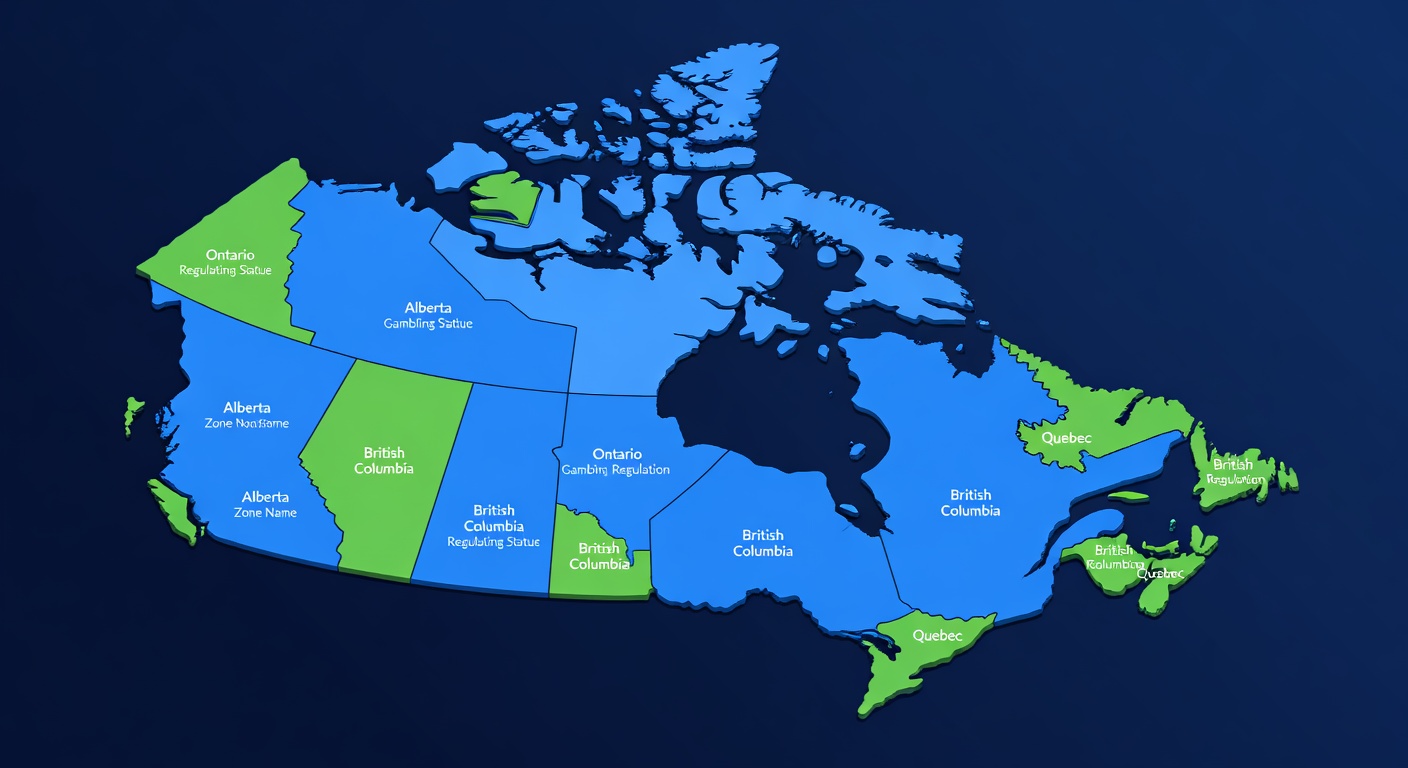
Canadian gambling policy is a federal compromise that became a provincial policy laboratory. Since the 1985 amendment to the Criminal Code transferred operational authority over gambling to the provinces, each province has made its own choices about what games to offer, how to operate them, who gets to advertise to residents, and what player protection measures to mandate. The result is a natural experiment that researchers interested in the public health effects of gambling regulation should pay closer attention to than they typically do.
I want to work through the regulatory landscape province by province and then, in the final sections, draw out what the divergences tell us about which interventions appear to move the needle on player outcomes and which do not. Some of what follows will be uncomfortable for advocates of stricter regulation and some of it will be uncomfortable for advocates of liberalization. The data, as far as we can tell from the available public health literature, does not cleanly endorse either position.
The provincial monopoly model, and its exceptions
Every province in Canada operates a Crown corporation or equivalent entity responsible for operating or licensing gambling. Loto-Québec, British Columbia Lottery Corporation, Ontario Lottery and Gaming Corporation, Atlantic Lottery Corporation, and so on. The formal theory behind the provincial monopoly model is that concentrating operation within a public entity internalizes the externalities of gambling: harms to the population become costs borne by the same government that collects the revenue. In principle, this alignment should produce more conservative operating decisions than a fully privatized market would.
In practice, provincial entities have historically operated much like private firms, because their revenue targets are set by governments that have grown dependent on the contribution to general revenues. Ontario's OLG, prior to the 2022 market opening, was generating several billion dollars in annual net profit flowing to provincial general revenues. That revenue relationship shapes the regulatory posture from the inside.
Ontario's 2022 decision to open its online market to regulated private operators under the iGaming Ontario framework represents the most significant policy break from the Crown monopoly model in Canadian history. Ontarians can now play at more than seventy licensed private operators, with iGaming Ontario acting as conduit between operator and the Alcohol and Gaming Commission of Ontario. Alberta announced plans in 2024 to move toward a similar model. Other provinces have not yet followed.
Advertising regulation: a source of significant provincial divergence
One area where provincial variation is especially pronounced is in the regulation of gambling advertising. The differences matter from a public health perspective because exposure to gambling marketing appears, in the available literature, to correlate with increased play intensity among at-risk gamblers, a finding consistent with work by Thomas and colleagues over the past fifteen years.
In Ontario, following market opening, the AGCO issued standards that restricted the use of athletes and celebrities in gambling advertising, effective February 2024. The policy was a response to visible public concern about the prevalence of sports-tied gambling advertising during the 2022 and 2023 sports seasons. Quebec's framework has maintained stricter controls on advertising targeting and frequency, administered through the Régie des alcools, des courses et des jeux. British Columbia and the Atlantic provinces have taken intermediate positions, with general restrictions on inducements but fewer specific rules on celebrity endorsement.
The divergence between these advertising regimes produces something close to a controlled comparison. Populations with similar demographic profiles are exposed to substantially different advertising environments, which offers an opportunity to study the relationship between advertising exposure and gambling harm that is rare internationally. To my knowledge the published research has not yet caught up with this opportunity.
Self-exclusion and player protection
All Canadian provinces operate self-exclusion programs, but the mechanics diverge. British Columbia's BCLC runs GameSense, which includes both self-exclusion and broader information programming. Ontario's OLG runs a self-exclusion program, and iGaming Ontario-licensed operators are required to integrate with a centralized exclusion list. Quebec maintains its own self-exclusion system through Loto-Québec.
The public health concern with self-exclusion is the well-documented gap between the enrollment decision and the effectiveness of the enforcement. A player who self-excludes from a land-based casino in Ontario is, in principle, denied entry. Enforcement in practice relies on face recognition, which is imperfect, and on staff detection, which is also imperfect. Hayer and Meyer's 2011 analysis of self-exclusion programs in German casinos found substantial breach rates that appear comparable in other jurisdictions where the research has been done.
The online environment presents a different architecture. Identity verification at account creation makes self-exclusion enforcement structurally more reliable, but only if the player cannot simply move to an unregulated offshore operator. This is the central tension in online gambling regulation, and it is not unique to Canada.
Age limits and the provincial threshold
Age limits diverge. Alberta, Manitoba, and Quebec set the minimum gambling age at 18. The remaining provinces set it at 19. The public health significance of a one-year age difference at that point in the life course is modest but not nothing. Brain development research suggests continued maturation of decision-making networks through the early twenties, and the Ontario Gambling Research Centre has sponsored longitudinal studies that find slightly elevated problem gambling rates among players who begin gambling before age 21.
The policy instrument is blunt. Shifting the threshold from 18 to 19 provincewide may capture some of the at-risk population but the much larger effect on onset age would come from a shift to 21, which no Canadian province has adopted and which would require considerable political work to put in place.
What the provincial variation actually suggests
Three observations stand out when the provincial policies are placed next to one another.
First, the choice of Crown monopoly versus regulated private operator market appears to have less effect on aggregate player outcomes than the specific player protection tools embedded in each system. A well-designed private operator regime with strict affordability checks and mandatory operator contributions to problem gambling services may produce better outcomes than a Crown monopoly regime without those features. This is consistent with Livingstone and Adams's 2016 analysis of gambling regulation across several English-speaking jurisdictions.
Second, advertising regulation appears to be one of the higher-impact provincial tools, precisely because it operates on the population of potential players rather than only on those already identified as at-risk. The reduction in visible celebrity endorsement following the AGCO standards is an intervention whose effects should be trackable in subsequent data.
Third, the structural fragmentation of Canadian regulation across provinces is itself a regulatory feature. Players who live in a province with stricter controls can in many cases access operators licensed in other jurisdictions, which undermines the local regime. The federal role in policing this leakage is limited, and the provinces have not, to date, coordinated effectively on cross-provincial enforcement.
For a researcher, the Canadian provincial system is a rare multi-jurisdictional comparison that ought to inform international policy debates. For a player, the practical implication is that the rules that govern what you see, what you can spend, and how your self-exclusion is enforced depend substantially on which province you are sitting in when you click.