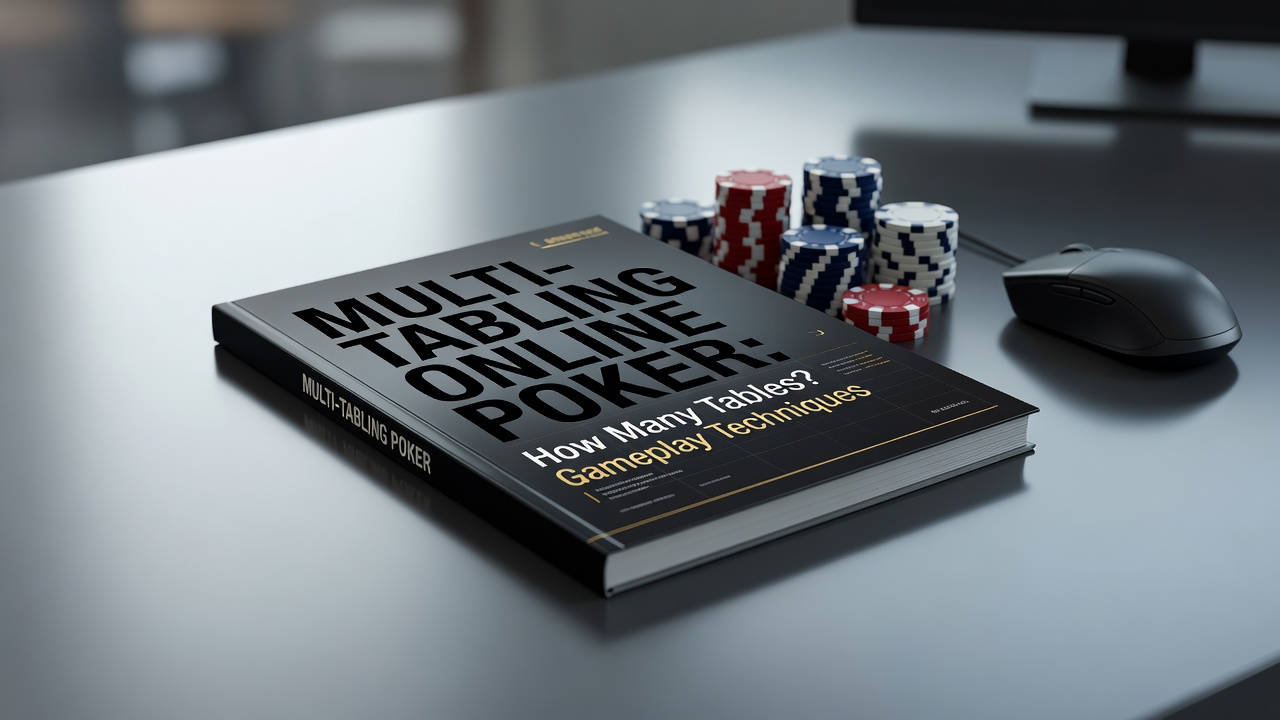
A professional online poker player named Jared sits at six tables simultaneously. Each table shows a 30-second decision timer. The math is immediate: 6 tables times 9 players equals 54 decisions per round, minus his own, means he faces approximately 48 opponent decisions before he acts again. If opponents average 8 seconds per decision, Jared has 384 seconds before he needs to act. He has 30 seconds per decision.
Multi-tabling is a systems-design problem wearing a poker costume. The constraints are clear: a human has limited attention, a computer screen has limited pixels, a decision timer is non-negotiable. The poker skill (understanding ranges, calculating equity, predicting behavior) is constant across all tables. The design problem is managing information overflow and decision latency.
The Onboarding Curve: Two Tables to Four
Most beginning multi-tablers start with two tables. The cognitive load is trivial. You fold most hands. When you fold, you can watch the other table. The only pressure is during your decisions on Table 1 while your opponent at Table 2 is acting. This is manageable.
At three tables, the load increases non-linearly. The overlap in decision windows grows. You are more likely to face a decision at Table 1 while deciding at Table 2. The retention hook changes. In single-table play, you are deeply invested in the outcomes of each decision. In three-table play, you care less about any individual outcome and more about the aggregate. Your brain notices this shift.
At four tables, the feedback loop changes. You lose the ability to see every action at every table. You are reactively opening your fold-check. You see a raising sequence starting at Table 2 but you are deciding at Table 3 and by the time you return to Table 2, the decision has been made without your input. The skill expression decreases. The task becomes managing information.
The optimal stopping point for most players is five tables, where the reward schedule supports continued focus without the variance of higher table counts breaking their emotional regulation.
The Skill Expression Problem: Five Tables to Eight
At five tables, professional players report that they have enough information density to maintain GTO-ish play while still making reads on opponents. The variance is manageable. The decision quality is acceptable. This is the equilibrium point where the game remains poker and has not become task management.
At six tables, something changes. The players who make this jump successfully are the ones who optimize their screen layout aggressively. They use poker-specific software that shows only the most crucial information: fold button, raise button, bet-amount controls. They remove the animation of chips sliding across the table. They mute the sound entirely. They are building a simplified interface because their brains can no longer maintain a full simulation of six games simultaneously.
At eight tables, the system approaches its limit for talented players. Professional multi-tablers report that eight is where they catch themselves making automatic decisions they did not intend. A hand is folded because they meant to limp but a pop-up from a previous table demanded a decision and they hit the wrong button. The cognitive load is approaching its peak.
The Retention Hook and the Mental State
Psychologically, multi-tabling creates a specific kind of engagement. You are not deeply invested in any single outcome. You are not, in fact, playing poker in the traditional sense. You are managing a reward schedule. Every few seconds, the system delivers a decision or a result: a check, a fold, a win, a loss.
Game designers call this a variable-ratio reinforcement schedule. It is the same mechanism that makes slot machines addictive. You receive a reward at unpredictable intervals, but the pattern encourages you to keep playing. A player multi-tabling at four tables reports feeling a dopamine hit from the frequency of decisions, even though each individual decision is less meaningful.
At nine tables, the research shows engagement drops. The feedback is too frequent to feel meaningful. It becomes background noise. Players report that nine-table play feels less like poker and more like hitting buttons in response to lights.
The sweet spot is five to six tables for skill expression and four to five for long-term emotional sustainability. Beyond that, you are optimizing for hourly volume, which works until variance hits, and then you realize you have been managing alerts instead of making decisions.