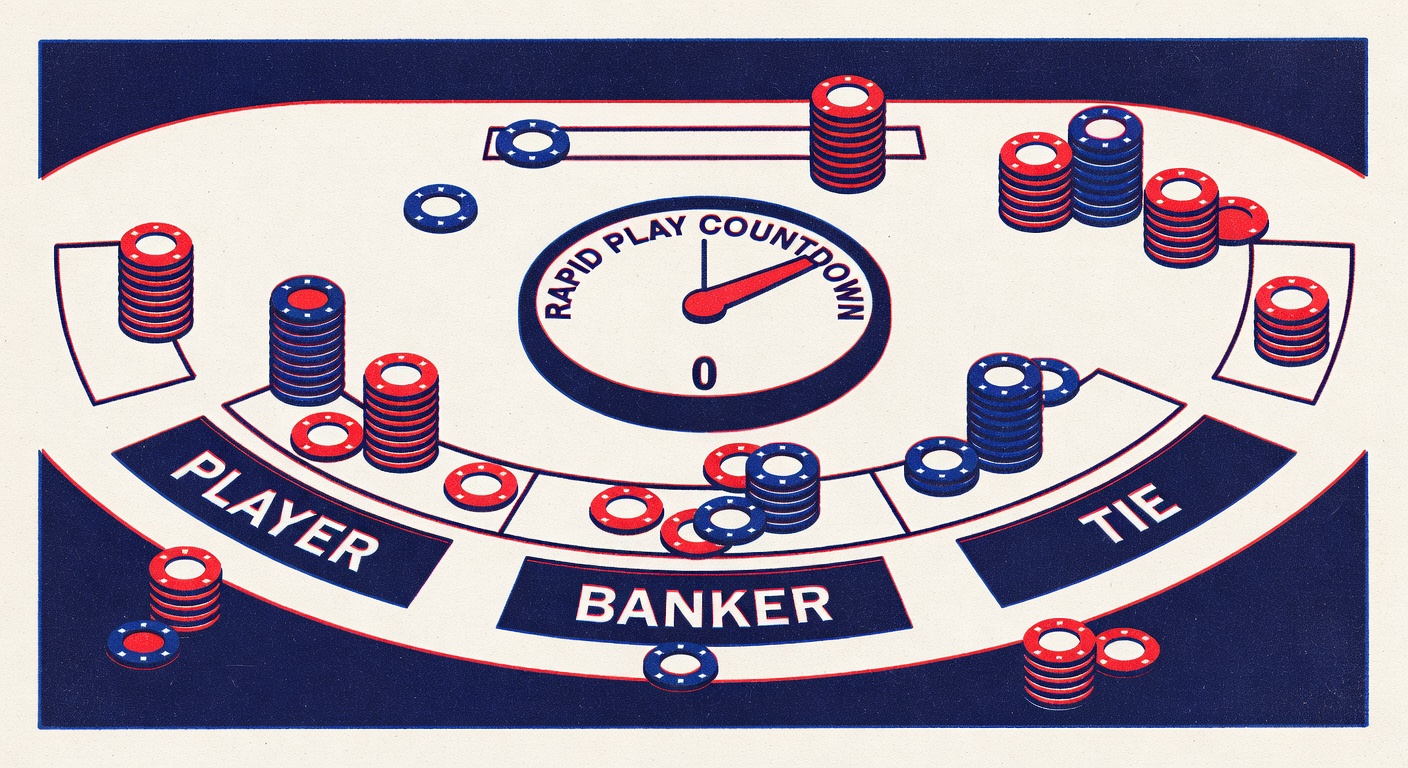
Speed Baccarat is the same game, only quicker. That is the pitch. Each round lands in roughly 27 seconds instead of the 48 you get at a standard live table. The cards are dealt face up from the start, the commentary is trimmed, and the countdown between hands disappears. From the operator side, this is straightforward: more decisions per hour means more expected revenue. From the player side, the pitch is different. Faster play feels efficient. It feels like you are getting more game for your time. The question is whether that feeling maps onto anything real, or whether it maps onto a well-documented set of cognitive tendencies that make quick play feel better than it is.
I want to take the question seriously, because baccarat already has one of the most player-friendly edges on the floor. The banker bet sits at a house edge of about 1.06 percent, the player bet at 1.24 percent. Those are numbers an experienced gambler respects. A reasonable person might look at Speed Baccarat and think: same edge, more hands, same entertainment density, why not. That reasoning has a flaw inside it, and the flaw is not arithmetic. The flaw is in how humans price the difference between an amount they have and an amount they expected to have.
Prospect theory and the shape of a losing hour
Daniel Kahneman and Amos Tversky published prospect theory in 1979, and nothing about online baccarat was on their mind. But the framework is almost too clean a fit. They observed that people do not weigh gains and losses symmetrically. A loss of 100 units hurts roughly twice as much as a gain of 100 units pleases. They also observed that people evaluate outcomes against a reference point rather than in absolute terms. That reference point shifts with context, and Speed Baccarat shifts it constantly.
At a standard table, variance is metabolized slowly. You might lose three hands, win two, lose one, and fifteen minutes have passed. The reference point updates gently. At Speed Baccarat, those same six hands take under three minutes. The brain has less time to anchor. Each new loss is measured against a reference that has not yet settled from the last one. Loss aversion compounds with itself. You are not playing more hands of the same game. You are playing in a neurological environment where the pain of each losing hand has nowhere to land before the next one arrives.
This matters because loss aversion is the engine of chasing. A study by Greg Barron and Ido Erev in 2003 looked at decisions from experience across rapid repeated trials and found that the hotter the feedback loop, the more aggressively people try to claw back losses through further bets. Speed Baccarat is the hot feedback loop in its purest form.
Mental accounting under time pressure
Richard Thaler's 1985 work on mental accounting describes how people segregate money into notional buckets: the entertainment budget, the rent money, the winnings that feel somehow freer than the original stake. These buckets are not rational divisions of fungible cash. They are psychological conveniences, and they do real work in guiding behavior.
Speed Baccarat disrupts mental accounting in two specific ways. First, a 100 unit bet repeated 120 times an hour does not register to the player as 12,000 units of exposure. It registers as a 100 unit decision, made over and over. The brain is evaluating each hand as its own small account. The aggregate exposure drifts above the ceiling that the player would have explicitly set for themselves.
Second, house money effects grow unstable. A standard-speed winning streak gives the brain time to mentally book the profits, move them into a separate bucket, and protect them. Speed Baccarat blurs this. The profits never quite sit still long enough to become real. They function more like ammunition for the next round. The 2006 study by Hal Arkes and colleagues on the house money effect found that people reliably take bigger risks with recently-won money, and that effect is amplified when the time horizon shrinks.
What a faster edge actually costs
House edge is denominated in percentage of money wagered, not percentage of money deposited. This is the move that catches most casual players. A 1.06 percent edge on banker bets sounds small. At 40 hands an hour with 100 unit bets, that is 42.4 units of expected loss per hour. Not pleasant, but bearable for an evening of entertainment. At 120 hands an hour, the same bet sizing produces 127.2 units of expected loss per hour. The edge per hand has not changed. The edge per hour has tripled.
Players often respond to this calculation by saying they will reduce their bet size at the faster table to compensate. In aggregate data, they mostly do not. Work by David Ludvig and colleagues on bet-sizing behavior in rapid-decision gambling environments found that players tend to hold bet size roughly constant even as decision frequency increases. The intention is there. The execution, under the light cognitive load of a 27 second countdown, is not.
The entertainment argument, honestly examined
There is a defense of Speed Baccarat that a behavioral economist should be willing to steelman. For some players, the entertainment value is real. A faster game is more engaging, more alert, more present. It demands attention. For a player who has budgeted a fixed amount for an evening and treats that amount as fully spent the moment it leaves their account, speed can genuinely deliver a better ratio of engagement to cost.
The problem is that this framing assumes a kind of player who can reliably hold the budget as a hard ceiling under real-time cognitive pressure. A minority can. Most cannot, and the honest way to describe Speed Baccarat to the median player is as a product that is very well engineered to make your budget feel softer than it is.
A modest conclusion
Speed Baccarat is not a scam. The math is the same math. The edge is the same edge. What changes is the architecture of the decision environment, and that architecture is unfriendly to the way human cognition actually works. If a player has read prospect theory, keeps a paper tally, sets a hand count rather than a time limit, and bets down to compensate for frequency, Speed Baccarat is defensible. If they have not, the product is quietly betting on their loss aversion doing their thinking for them. The house does not need a bigger edge. It just needs the clock to run faster than your reference point can update.