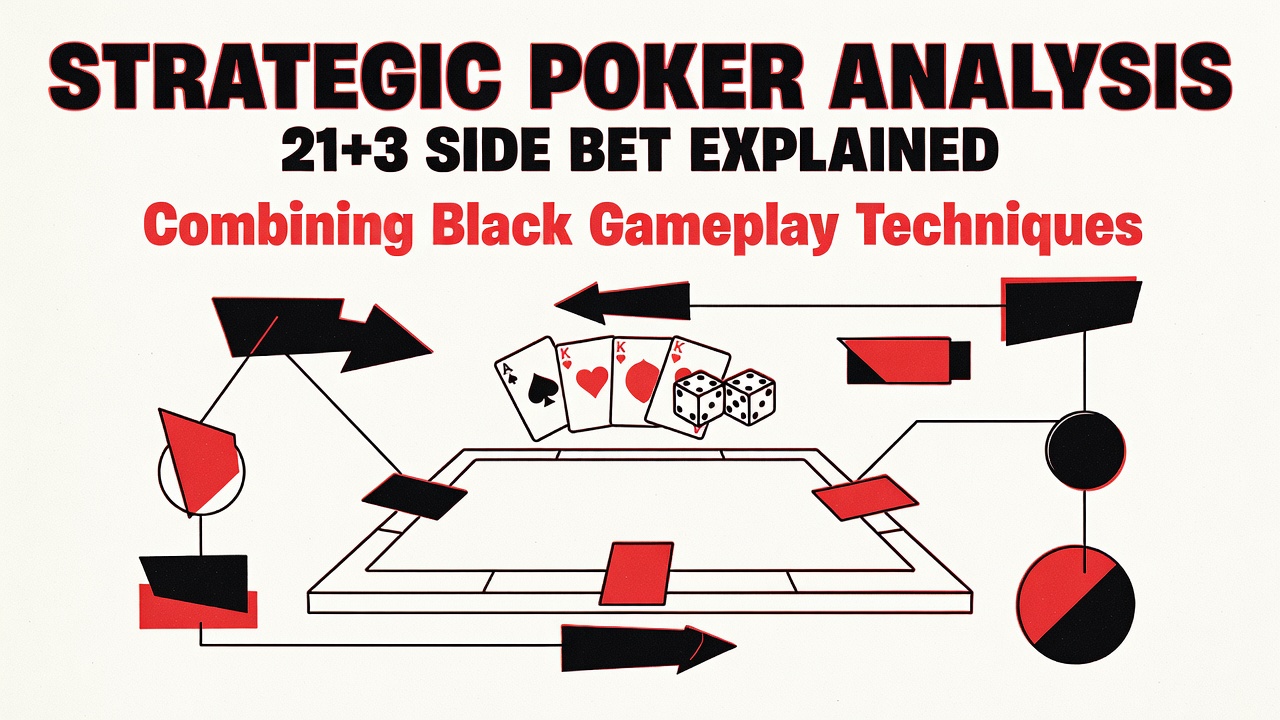
The 21+3 side bet works like this: you make a separate bet alongside your standard blackjack bet. Your two cards plus the dealer's up card form a three-card poker hand. If the hand ranks (flush, straight, trips, etc.), you win the side bet. If not, you lose it.
The winning combinations are:
- Straight flush (three cards in sequence, all same suit): pays 40:1
- Three of a kind (three same-rank cards): pays 30:1
- Straight (three cards in sequence, mixed suits): pays 10:1
- Flush (three same-suit cards): pays 5:1
Sounds generous. A 40:1 payout on a straight flush seems valuable. Let's check the probability. A three-card straight flush can occur in exactly twelve ways: A-K-Q of each suit (4), K-Q-J of each suit (4), Q-J-10 of each suit (4). That's twelve favorable outcomes out of 22,100 possible three-card combinations. The probability is 0.054%, which means 1 in 1,852.
Betting 1 unit on a 40:1 payout at 1 in 1,852 odds has expected value of (40/1852) = 0.0216 units. You're paying 1 unit, expecting to win 0.0216 units. The return is 2.16%. This is a negative-expectation bet. You expect to lose 97.84% of your wager.
The house edge on the 21+3 side bet is approximately 3.77% across all outcomes combined. The breakeven required probability is 50% (for a 1:1 bet). The actual probability of any winning combination is much lower. The payout structure is designed to look attractive while maintaining heavy house edge.
The Practical Analysis
This is higher than blackjack's standard house edge (around 0.5% with basic strategy). You're paying a premium for entertainment value. Some players accept this, knowing they're paying for the additional excitement.
- Straight flush: 1 in 1,852. Payout 40:1. House edge: 97.84% on this bet alone
- Three of a kind: 1 in 424. Payout 30:1. House edge: 92.93%
- Straight: 1 in 423. Payout 10:1. House edge: 76.36%
- Flush: 1 in 143. Payout 5:1. House edge: 65.03%
You don't bet these individually. You bet on any of these combinations occurring. The combined probability is roughly 1 in 70. The combined expected payout (weighting each outcome by its probability) is positive at long odds but negative when compared to the cost of one-unit bet.
"The 21+3 side bet is pure entertainment. The actual expected value is deeply negative. But it's cheaper than buying a ticket to a show, and some players value the excitement."
Casinos love side bets because they add marginal revenue. A player making a ten dollar blackjack bet might add a five dollar 21+3 side bet. The blackjack bet has a small house edge (assuming basic strategy). The 21+3 bet has a large house edge. The casino's profit per hand increases without changing the base game.
Comparison to standard blackjack: A ten dollar blackjack bet at 0.5% house edge generates fifty cents expected loss. Adding a five dollar 21+3 bet at 3.77% house edge generates 18.85 cents expected loss. The combination increases house profit from fifty cents to 68.85 cents per hand, a 38% increase in casino revenue per hand.
For serious players, side bets are strictly avoided. They're a bad financial decision. For recreational players who understand they're paying for entertainment, they're tolerable. The decision is whether the additional excitement is worth the premium expected loss.