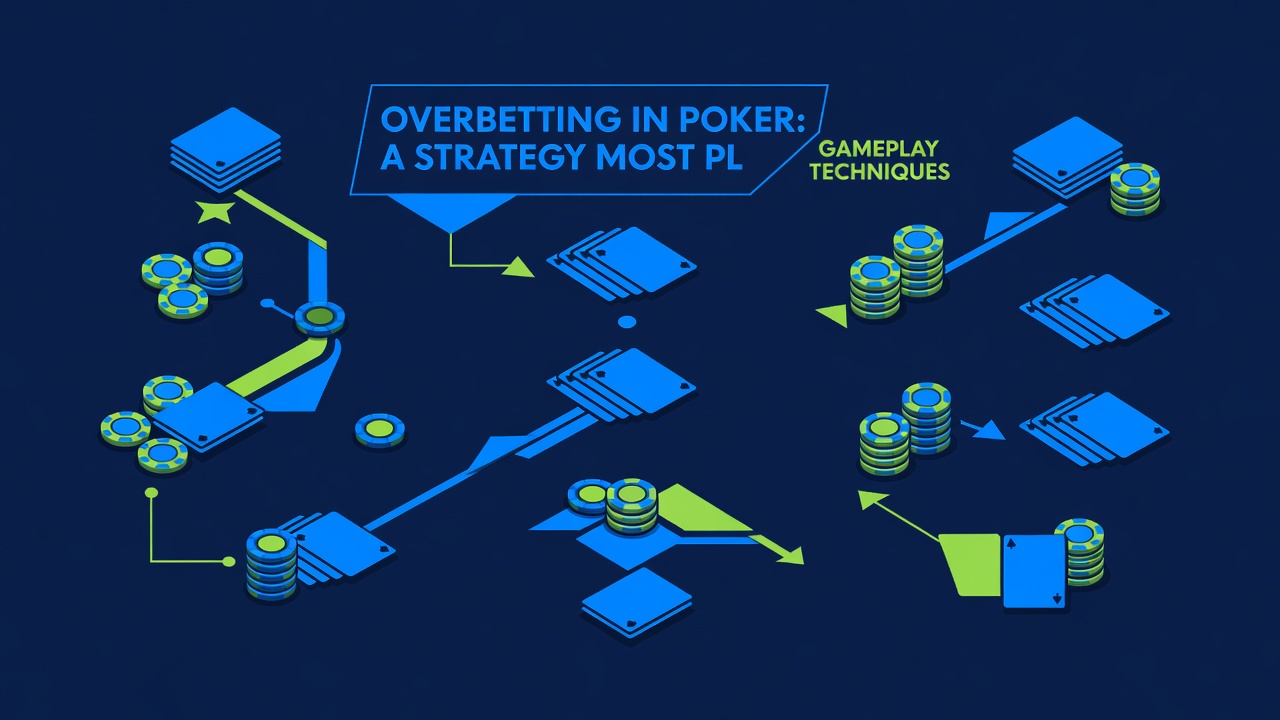
Claim: Overbetting in poker signals weakness and gets you called down too often.
Reality: This claim confuses overbetting with bad bet sizing. Overbetting is a specific strategy, not a mistake.
In poker, an overbet is a bet that exceeds the pot size. If the pot is fifty dollars, an overbet is anything above fifty dollars. A common example: you bet eighty dollars into a fifty-dollar pot.
The behavioral claim is that overbets signal weakness because you're risking too much relative to the pot. A strong player would bet less and still win the pot. A weak player bets too much because they're not confident.
The reality is more detailed. Overbetting serves the strategy of exploiting specific psychological patterns. When you overbet, you polarize the decision. Your opponent can call or fold, but the math becomes unfavorable for marginal hands.
Consider an example. Pot is fifty dollars. You have a strong hand. You bet eighty dollars. Your opponent has a middling hand worth perhaps thirty dollars. The decision becomes: call eighty to win fifty (or ninety total), risking thirty of my stack to win fifty of yours.
That's unfavorable pot odds for the marginal hand. So the marginal hand folds. The overbet causes hands to fold that might call a more conventional bet.
The strategic purpose is reducing the number of hands your opponent plays against you. This is useful when your hand is strong but not obviously strong. When you're confident in the strength of your position, overbetting simplifies the decision tree.
Why People Fear Overbetting
The fear stems from prospect theory. Humans are loss-averse. When you overbet, you're risking more chips. The loss feels bigger psychologically than the gain from forcing weaker hands to fold.
If the overbet wins the pot uncontested, the gain is modest. You win fifty dollars. If the overbet loses, you lose eighty dollars. The asymmetry feels bad even if it's profitable over time.
Behaviorally, this manifests as a bias against overbetting. Skilled players overbet sometimes because it's profitable. Unskilled players avoid it because it feels scary.
The Actual Data
Studies on poker play show that skilled players overbet more frequently than unskilled players. This suggests overbetting is a skill indicator, not a mistake indicator.
The frequency is not high. Even skilled players overbet perhaps once every thirty hands. But when they do, it's typically in spots where the math supports it.
When overbets get called down, the skilled player has usually overbetted with a strong hand. The call is a mistake by the opponent, not evidence that overbetting is bad.
Why The Misconception Persists
The misconception persists because overbetting is visible. When you overbet and lose, the hand sticks in memory. You lost money. The big bet feels like it caused the loss.
When you overbet and win, you remember winning, not the specific bet sizing. You remember the outcome, not the strategy.
This creates an availability bias. Overbetting losses are more memorable than overbetting wins. So the psychological association is negative.
But the mathematical reality is that overbetting in specific situations is profitable. The fear is valid psychologically but incorrect strategically.
Understanding this distinction is what separates skilled players from fearful ones.