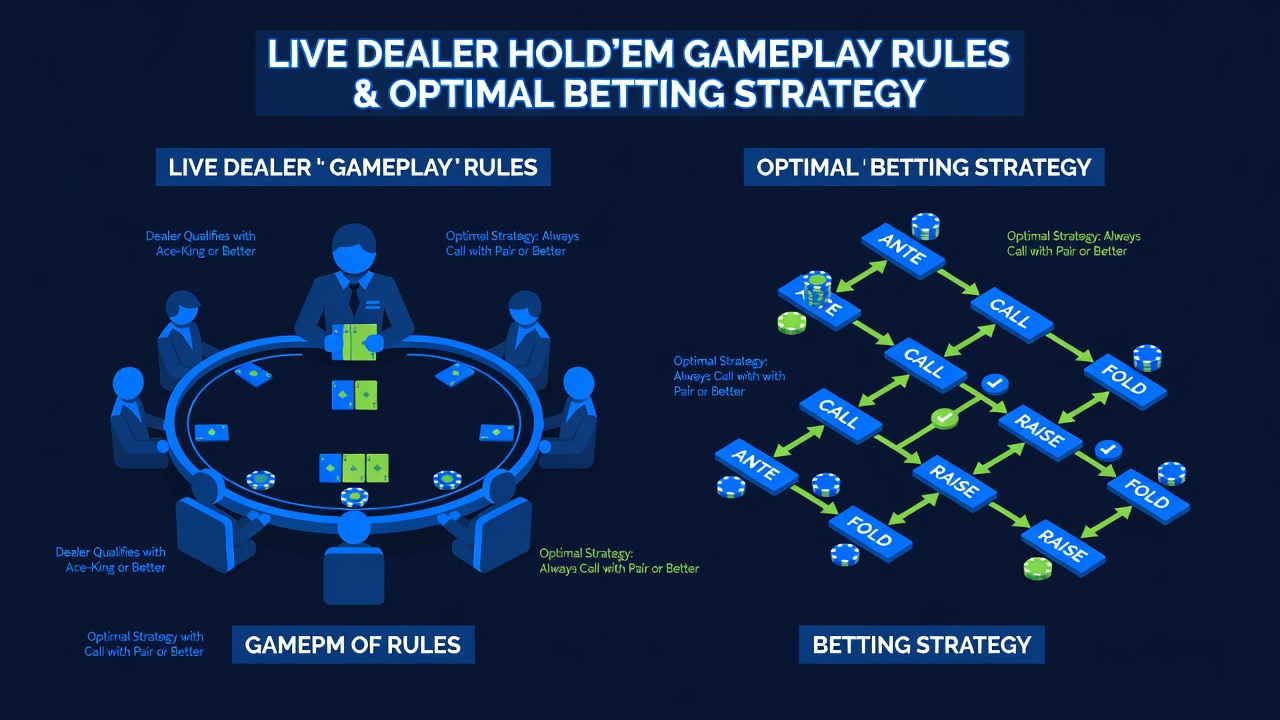
Casino Hold'em is not poker. This is the first thing to understand. It's a table game that uses poker hand rankings and community cards. The game works like this: you post an ante, receive two cards, and then have to decide whether to fold or raise based on partial information. No betting rounds with opponents. No position. No reads.
The structure is tight and repetitive by design. Each round follows an identical pattern. You see your two cards. You can fold, losing your ante, or raise by 1-4 times your ante. The dealer then reveals a community card and two more community cards on the turn. Finally, the river card comes. The dealer's hand must qualify (pair of fours or better) for your raise to mean anything. If the dealer doesn't qualify, you win your raise automatically.
The interesting part: the odds you're facing are fixed and calculable. There are 1,326 possible two-card combinations you could have. For each combination, the probability of winning, losing, or pushing against the dealer's distribution is mathematically determined. This is not a game of reading opponents. It's a game of probabilities against a statistical dealer.
Strategy Framework
Winning at Casino Hold'em requires knowing which starting hands justify a raise. The math breaks into three categories: premium hands (AA, KK, QQ, AK, AQ) that raise always; strong hands (JJ, TT, AJ, KQ) that raise in most positions; and weaker hands that require specific conditions.
Position in Casino Hold'em is unusual. You play one hand per round, not nine. What matters is the strength distribution of your hand relative to the dealer's entire range. The dealer is not tailoring strategy to your raise. You're betting against the house's defined hand distribution.
The flop decision is the critical skill point. You've now seen five cards total. You can check or call the dealer's bet. You know the odds of completing your draw or hitting your pair on the turn and river. The key: knowing your equity against the dealer's continuing distribution. If you have a flush draw, you're looking at roughly 35% equity on two cards. That often justifies a call depending on the odds offered.
Turn decisions are mechanical once you understand the math. You either have it or you don't by then. The river is binary: win or lose.
The Variance Element
Casino Hold'em is pure variance because you have no influence over other players. You can't slow-play a hand or run a bluff. The dealer's action is predetermined. This means swings are violent. You can play perfectly and lose thirty hands in a row through variance alone.
Bankroll management is not optional. The game's structure creates unforgiving downswings. A session of 100 hands at 1-unit ante bets can see you down 30 units or up 25 units on identical strategy. This is not slop; it's the nature of the game.
Comparison to Poker
In poker, you win by understanding position, opponent tendencies, and pot odds. In Casino Hold'em, you win by understanding hand strength and equity. Poker is about the people. Casino Hold'em is about the math.
This matters psychologically. Poker players often struggle at Casino Hold'em because they expect to outplay someone. There is no one to outplay. The house doesn't adapt. Your only edge is correct decisions against a fixed distribution. If you're in a live casino and you see someone talking about "reading the dealer," they're already losing.
The House Edge
Casino Hold'em, played with optimal strategy, carries a house edge of roughly 2.4%. This is significantly better than roulette or most slots. It's comparable to blackjack with basic strategy. The variance is higher than blackjack, but the math is better than baccarat.
The actual edge varies slightly by table rules. Some casinos offer better odds on the final bet. Others take a stronger commission. Read the placard. The math is all in the rules.
Why It's Designed This Way
Casino Hold'em's rigid structure serves the house. No collusion is possible. No table dynamics. The game scales: you can run fifty tables with one dealer feeding cards to a video screen. The outcome is pure probability.
For the player, this means either you understand the mathematics or you're playing on emotion. There's no middle ground. The game doesn't reward intuition. It rewards correct decision-making against known odds. That clarity is either appealing or frustrating depending on how you think.